

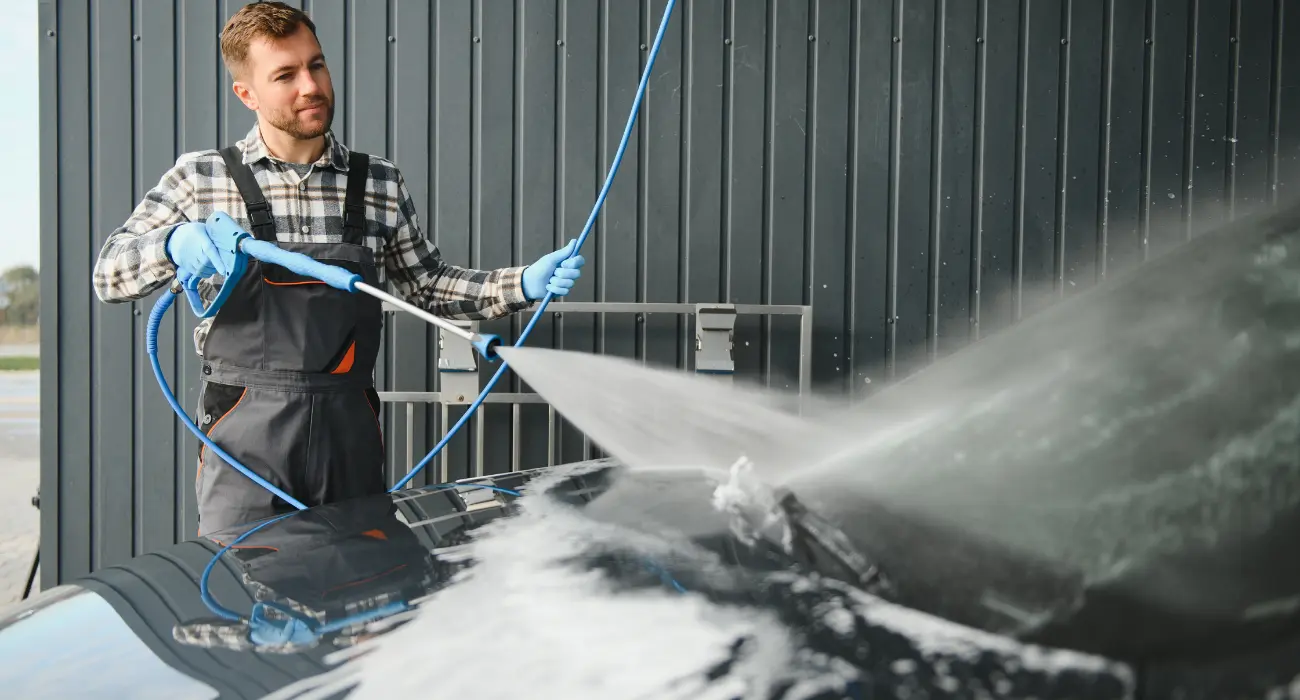
To start a mobile car wash business, register and insure the business, buy a compact kit built around a water-safe washing method, set clear packages and prices, and build routes of repeat customers in the same neighbourhoods and business parks. The fastest path to steady income is recurring work: weekly or fortnightly home clients and fleet contracts with companies that run vans or cars.
This guide covers how to start a mobile car wash business in the US, the UK and Nigeria, including the wash-water rules many new operators miss.
Key takeaways
- The market is huge: hundreds of millions of vehicles in the US and over 40 million in the UK.
- Don't let dirty water reach storm drains. Waterless, rinseless or water-capture methods keep you compliant and mobile.
- Fleets (vans, company cars, ride-hailing drivers) give volume in one location.
- Memberships and recurring bookings turn one-off washes into predictable income.
How big is the market for mobile car washing?
Every registered vehicle is a potential customer, and convenience is the whole pitch: you come to them.
- 297.5M motor vehicles registered in the US in 2024 US Federal Highway Administration, Highway Statistics 2024
- 42.3M licensed vehicles in the UK at the end of 2025 UK Department for Transport, 2026
Nearly 5 million vans in the UK is the number to notice. Vans belong to tradespeople and businesses that want clean, branded vehicles and can’t spare the time to queue at a car wash. The same logic applies to delivery fleets, rental companies and ride-hailing drivers in Lagos, Abuja, Houston or London.
Step 1: Pick your services and customers
| Service | Time per vehicle | Who buys |
|---|---|---|
| Exterior wash | 20–40 minutes | Busy professionals, office car parks |
| Wash and interior vacuum | 45–75 minutes | Families, regular home clients |
| Full valet or detail | 2–5 hours | Car enthusiasts, sellers preparing a car |
| Fleet wash | 15–30 minutes per van | Trades, delivery and rental companies |
| Add-ons | Varies | Clay bar, wax, upholstery shampoo, headlight restoration |
Start with two packages and one or two add-ons. Detailing earns more per hour but takes skill; basic washes build volume and recurring routes.
Step 2: Choose a water-safe method
This is the step most new operators skip, and it can lead to fines and complaints.
| United States | United Kingdom | Nigeria | |
|---|---|---|---|
| The rule | Cities must prohibit non-stormwater discharges to storm sewers under Clean Water Act stormwater permits, and many require mobile washers to contain and collect wash water (for example, Portland’s guidance). Some cities require a permit for mobile washing. | Run-off from vehicle cleaning must not enter surface water drains, surface waters or groundwater. Discharging trade effluent to a foul sewer needs the water company’s consent (GOV.UK). | State environmental protection agencies regulate pollution and drainage; ask yours about wash-water disposal, especially in estates and business parks |
| Practical approach | Waterless or rinseless products, drain covers, and water-capture mats with a recovery pump | The same, plus permission from car-park owners | Rinseless methods save water where supply is limited; get estate or car-park permission |
Step 3: Register, insure and get permission
| United States | United Kingdom | Nigeria | |
|---|---|---|---|
| Business registration | LLC or sole proprietorship; free EIN from the IRS; local business licence (SBA) | Sole trader (Self Assessment once trading income tops £1,000) or £100 limited company (Companies House) | Business name or company with the CAC; TIN |
| Insurance | General liability plus garage-keepers or care, custody and control cover for customer vehicles | Public liability and motor trade or “customer vehicle” cover | Public liability and vehicle insurance |
| Site permission | Property managers for office parks and apartment complexes | Car-park and land owners; a street trading licence if you trade on public streets (GOV.UK) | Estate management and car-park operators |
Step 4: Budget your startup costs
These are planning estimates, not quotes. Using a vehicle you already own keeps costs low.
| Cost item | Planning estimate (US / UK) | Notes |
|---|---|---|
| Vehicle | Use your own, or a used van $8,000–$20,000 / £6,000–£15,000 | Branded vans double as advertising |
| Water tank, pump and capture mat | $300–$1,500 / £250–£1,200 | Size for your method; rinseless needs far less |
| Pressure washer and generator (optional) | $400–$2,000 / £300–£1,500 | Only if your method and site rules allow |
| Vacuum, extractors, polishers | $200–$1,500 / £150–£1,200 | Detailing tools as you add services |
| Chemicals, towels, brushes | $200–$600 / £150–£500 | Buy concentrates to cut cost per wash |
| Insurance (first year) | $800–$3,000 / £500–£2,000 | Customer-vehicle cover is essential |
| Booking website and branding | $300–$3,000 / £250–£2,500 | Online booking and memberships |
In Nigeria, many operators start with a motorcycle or car carrying a rinseless kit, which keeps costs low and gets through traffic. Budget for fuel, a reliable phone for WhatsApp bookings, and water storage if supply is irregular. Buy in naira at current prices.
Step 5: Price packages with route maths
Worked example (replace with your numbers):
- Wash and interior vacuum: $45, taking 60 minutes including setup.
- Chemicals and towels per car: $3. So each wash contributes $42.
- If customers are spread out, you lose 30 minutes driving between jobs: 6 cars a day, $252.
- If you cluster clients in one apartment complex or office park, travel drops to 5 minutes: 8 cars a day, $336.
- A fleet contract for 20 vans at $22 each, 20 minutes per van: about 7 hours on one site for $440 a visit (less chemicals).
Clustering turns the same hours into a third more revenue, and fleets add volume without travel. That’s why the best mobile car wash businesses sell by location.
Myth vs fact
- MythA mobile car wash needs a big water tank and a pressure washer.
- FactRinseless and waterless methods clean most cars with minimal water and no run-off, which is cheaper, faster and easier to keep compliant.
- MythOne-off washes are the main business.
- FactRecurring weekly or fortnightly clients and fleet contracts provide steady income. Memberships raise customer lifetime value.
Turn one-off washes into memberships
A membership is a fixed monthly price for a set number of washes, booked on a regular schedule. It smooths your income through quiet weeks and makes route planning easier, because you know where you’ll be.
A simple structure: a fortnightly exterior wash for one price, a fortnightly wash and interior for a higher price, and a quarterly full valet as an add-on. Take payment by card or direct debit monthly, set a minimum term of three months, and let members skip a visit with notice. Offer households with two cars a second-vehicle discount; it’s another car at the same stop.
Step 6: Get your first customers
First 60 days
-
Choose two target areas
One residential (apartment complexes, estates) and one business area (office parks, depots).
-
Get permission
Speak to property managers and estate officers before you start.
-
Launch online booking
Packages, prices, areas covered, and a membership option.
-
Offer a launch week
Discounted first wash in exchange for a review and rebooking.
-
Pitch five fleets
Trades, delivery companies, car rentals and ride-hailing driver groups.
-
Automate reminders
Send rebooking reminders by SMS or WhatsApp after each wash.
The first wash is the expensive one, because you paid to find that customer. The money is in the second, third and tenth. So I'd set up the rebooking reminder before launch week, not after. A short WhatsApp or SMS message with a one-tap booking link, sent at the right interval, often does more for revenue than another round of flyers.
Step 7: Market locally and automate rebooking
People search “mobile car wash near me” and book whoever looks trustworthy and available. A complete Google Business Profile with photos, reviews and service areas is your shopfront; that’s local SEO. After the first wash, automated reminders and memberships do the selling. Our marketing automation team builds these flows for service businesses.
Before your first wash
- Business registered and insured, including customer-vehicle cover
- Water-safe method chosen and capture kit ready
- Site permission from property managers or car-park owners
- Packages, prices and cancellation policy published
- Online booking with reminders
- Before-and-after photo routine for reviews and social media
Mobile car wash business FAQs
Frequently asked questions
How much does it cost to start a mobile car wash business?
If you use your own vehicle and a rinseless kit, you can start with a few hundred to a few thousand dollars or pounds for supplies, insurance and a booking website. A used van, tank and detailing tools raise that substantially.
Do I need a permit for a mobile car wash?
You need to register the business and may need a local business licence. Some US cities require a mobile washing permit, and both US and UK rules prohibit dirty wash water entering storm or surface drains. Always get the property owner's permission.
Do I need a physical shop?
No. That's the point of a mobile business. You need a vehicle, a compliant washing method, a booking system and somewhere to store supplies.
How do I get customers for my mobile car wash?
Focus on dense areas like apartment complexes and office parks, set up a Google Business Profile, offer memberships, and pitch fleet operators who need many vehicles cleaned in one place.
Is a waterless car wash safe for paint?
Quality waterless and rinseless products with plenty of clean microfibre towels are designed for lightly to moderately soiled cars. Heavily muddy vehicles need a pre-rinse with water capture first.
Ready to grow your routes? A growth audit shows where your site and local listings lose bookings.