To start a fashion brand from scratch, you need four things before you need a big budget: a clear customer, a small first collection, a reliable maker, and a price that covers your real cost per piece. Most new clothing brands fail on stock, not design. They order too much of the wrong thing and run out of cash waiting for it to sell.
This guide walks through launching a fashion brand in small, low-risk steps, with registration and labeling basics for the US, UK and Nigeria, a startup-cost table and the pricing maths.
Key takeaways
- Start with three to six pieces, not a full collection.
- Produce small runs or pre-sell. Unsold stock is the biggest risk in fashion.
- Price from landed cost per piece, then check the wholesale math works.
- In the US, clothing labels must show fiber content, country of origin and who made or sells it.
Who will wear it? Define the brand before the clothes
A fashion brand is a promise to a specific person. “Affordable streetwear for everyone” is not a brand. “Modest workwear for women in Lagos who commute in heat” is. The narrower version tells you fabrics, cuts, price range, where to advertise and what to post.
Write down:
- Who: age range, city, job, what they wear now and where they buy it.
- Why you: fit, fabric, culture, size range, sustainability or price, but pick one lead reason.
- Price band: what your customer pays today for a similar item.
If this is hard, our guide to identifying your target audience helps. A brand name and visual identity come after this, not before. Our branding glossary entry covers what that work involves.
What the fashion design trade looks like
Many fashion designers work for themselves, which is good news for independent founders. It also means you compete with a lot of small labels, so positioning matters.
- $80,960 US median annual wage for fashion designers, 2025 US Bureau of Labor Statistics, 2026
- 32,700 fashion designer jobs in the US, 2025 US Bureau of Labor Statistics, 2026
BLS projects little or no change in fashion designer jobs from 2025 to 2035. Translation: growth comes from building your own label and customer base, not from waiting for the industry to expand.
How to start a fashion brand, step by step
From idea to first drop
-
Define the customer and the one reason they'd choose you
Write it in a sentence and test it on ten people who match.
-
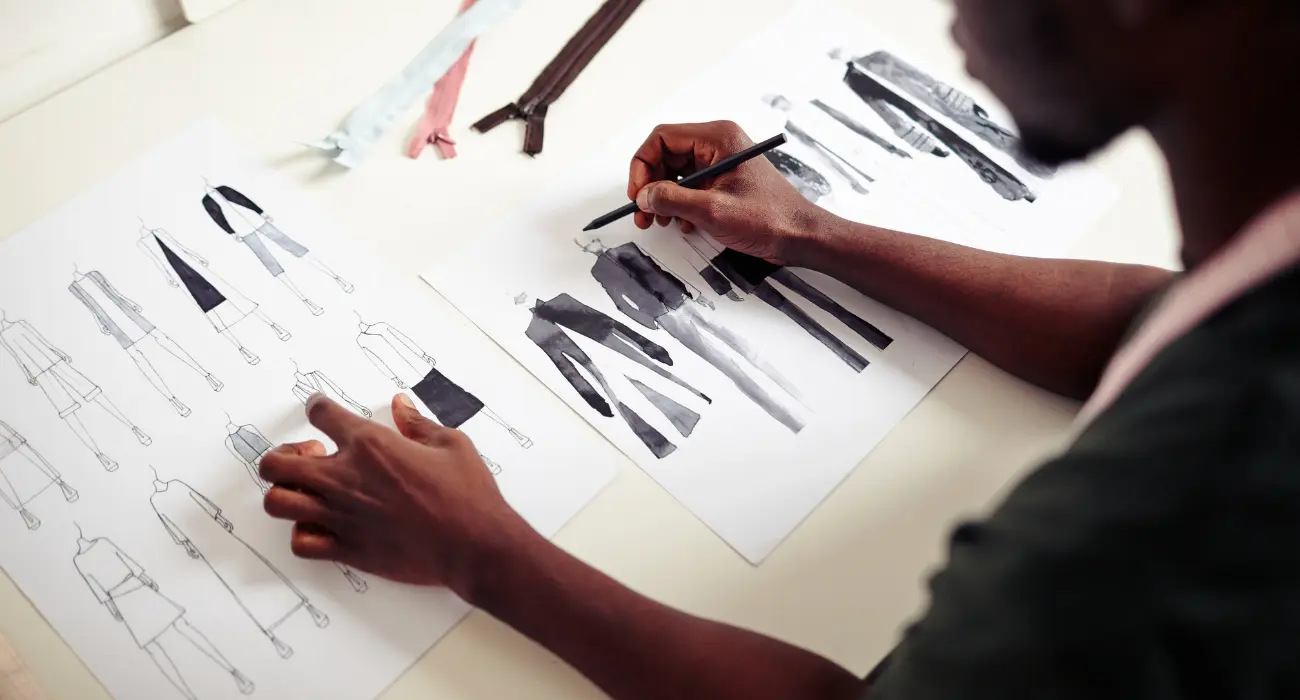
Design three to six core pieces
Pieces that work together and that you can remake. Skip seasonal extras for now.
-
Make samples
Get one sample per style, wear-test it, wash-test it, and fix fit before any production.
-
Choose your maker
A local tailor or small workshop for runs under 50 units; a factory once you know what sells.
-
Register the business and protect the name
Register the company and check the name is free to trademark in your main market.
-
Label correctly
Fiber content, care instructions, country of origin and your business details, following your market's rules.
-
Build pre-launch demand
Share the making process, fittings and fabric choices for four to six weeks before launch.
-
Launch a small drop or pre-order
Sell a limited run or take pre-orders so production matches demand.
-
Reorder what sells
Restock winners. Drop or redesign slow pieces. Then add new styles.
Registration and labeling in the US, UK and Nigeria
| United States | United Kingdom | Nigeria | |
|---|---|---|---|
| Register the business | LLC or sole proprietor with your state; free EIN from the IRS | Sole trader with HMRC, or Ltd with Companies House (£100 online) | Business name or company with CAC |
| Protect the name | Trademark search and filing with the USPTO | Trademark with the UK Intellectual Property Office | Trademark with the Trademarks Registry, Federal Ministry of Industry, Trade and Investment |
| Labels | Fiber content, country of origin and maker or seller identity are required; care labels are a separate FTC rule | Follow UK textile labeling rules for fiber content | Use clear fiber, care and maker details; check SON guidance for your product type |
Sources: FTC textile labeling guide, IRS, GOV.UK.
How much does it cost to start a fashion brand?
These are planning ranges for a small first drop of three to six styles. Production costs vary hugely by fabric, country and quantity, so get at least three quotes.
| Cost item | Estimate | Basis |
|---|---|---|
| Samples (1 per style) | $50–$150 per style | Planning estimate; get maker quotes |
| First production run (20–50 units per style) | $500–$3,000 | Planning estimate; fabric drives most of it |
| Labels, tags and packaging | $100–$400 | Planning estimate |
| Product photography | $150–$800 | Planning estimate |
| Business registration | Under $300 (US); £100 Ltd (UK); CAC fee (Nigeria) | SBA, GOV.UK |
| Online store | $0–$40 per month plus payment fees | Planning estimate |
| Launch ads budget | $200–$1,000 | Planning estimate; test small first |
Pricing a clothing brand: the worked example
Price from your landed cost: everything it took to get one finished piece ready to sell.
- Fabric: $9 · Cutting and sewing: $8 · Trims, label and tag: $2 · Packaging: $1 · Shipping in: $2
- Landed cost: $22 per shirt
- Direct-to-customer price at roughly 3× landed cost: $66. After a 3% payment fee and $8 of ad spend per sale, you keep $66 − $2 − $8 − $22 = $34.
- Wholesale to a boutique at roughly half of retail: $33. Your margin: $33 − $22 = $11. Workable, but only at volume.
If the wholesale number doesn’t work, either cut landed cost (fabric, quantity) or stay direct-to-customer until you can. The same logic applies in naira or pounds.
How to market a new fashion brand
- Show the making. Fabric sourcing, fittings and sample fails build trust and pre-launch interest.
- Use creators who already dress your customer. Send pieces to five micro-creators whose followers match your buyer.
- Run small paid tests. Spend a little on two or three ad variations, keep the winner, and scale it. Our paid ads team covers how to structure tests.
- Hashtags help discovery on some platforms. Use specific ones over generic ones. Our free hashtag generator gives you a starting list.
- Own the customer list. Collect emails and phone numbers at every sale. Drops sell faster to people who already bought.
Common mistakes new fashion founders make
- Ordering every size in every color. Start with your best-selling colorway and core sizes, then expand based on sales data.
- Skipping the wash test. Shrinkage and color bleed generate returns and bad reviews. Wash every sample at least twice.
- No written agreement with the maker. Put price per unit, quantity, quality standard, lead time and what happens with defects in writing.
- Spending the launch budget on the logo. A clear identity matters, but your first money should go into samples, fit and photography that sells the product.
Fashion founders often build a beautiful brand that's hard to buy from. Before the launch shoot, I'd check the basics: a size guide with real measurements, clear delivery and returns, and product photos on bodies like your customer's. Those answer the questions that stop a first purchase. Then collect every buyer's email, because your second drop sells to them first.
Myth vs fact
- MythYou need a full collection to launch a fashion brand.
- FactMany labels launch with a handful of core pieces. Fewer styles mean less unsold stock and clearer marketing.
- MythYou must design every piece yourself.
- FactMany founders work with a freelance designer or pattern cutter. Your job is the brand direction, the customer and the quality bar.
- MythClothing labels are optional for small brands.
- FactIn the US, textile labels must show fiber content, country of origin and the maker or seller. Care labels are required by a separate FTC rule.
Launch checklist
- Customer and positioning written in one sentence
- Samples wear-tested and wash-tested
- Maker chosen, with a written price per unit and lead time
- Business registered and name checked for trademark conflicts
- Labels meet your market's rules
- Landed cost and retail price calculated per style
- Online store, size guide and returns policy live
- Pre-launch content plan for four to six weeks
Frequently asked questions
How much money do I need to start a fashion brand?
It depends on how many styles you launch and how many units you make. A small drop of three to six styles in short runs keeps the first spend low. Pre-orders reduce the cash you need even further, because customers pay before you produce.
Can I start a clothing brand without knowing how to sew or design?
Yes. You can hire a freelance designer, pattern cutter and tailor or factory. You still need to own the customer, the brand direction and quality control, and you should wear-test every sample yourself.
How long does it take to launch a fashion brand?
Plan for sampling, production and a few weeks of pre-launch marketing. Sampling often takes more than one round to get the fit right, so build time for revisions rather than fixing a launch date first.
What should a clothing label include?
In the US, the FTC requires fiber content, country of origin and the identity of the maker or seller, plus a care label under a separate rule. UK and Nigerian rules also expect clear fiber and care information. Check your market's regulator before printing.
Should I sell online or in stores first?
Online first is usually cheaper and lets you test demand quickly. Pop-ups and boutiques work well once you have a few proven best-sellers and a wholesale price that still leaves margin.
Next step
Write your one-sentence brand promise and test it on ten potential customers this week. When you’re ready to sell online, a fast, mobile-friendly store matters. See website design at TechDella Studios.