
A Comprehensive Guide on How to Develop an MVP for Your Startup
Learning how to develop an MVP is one of the smartest things a startup founder can do before spending months and thousands of dollars building a full product.
An MVP, or minimum viable product, is not a cheap version of your dream product. It is not a half-built app. It is not a rushed prototype with broken features. A good MVP is the simplest useful version of your product that helps you test one important question: Do people actually want this?
Many startups fail because they build based on assumptions instead of real customer behavior. CB Insights’ latest startup failure research continues to list lack of product-market fit as one of the top reasons startups fail. That is exactly why MVP development matters.
For founders, the goal is not to build everything. The goal is to learn fast, reduce waste, and create something real users can respond to.
This guide explains how to develop an MVP for your startup step by step, from idea validation to launch, user feedback, metrics, and iteration.
What Is an MVP?
An MVP is the smallest version of a product that allows a startup to test whether users find real value in the idea.
Eric Ries popularized the MVP through the Lean Startup method, where startups use a build-measure-learn loop to test assumptions quickly. The Lean Startup framework describes the MVP as a way to begin learning as fast as possible with the least unnecessary effort.
A strong startup MVP should do three things:
- It should solve one clear problem.
- It should serve one specific user group.
- It should help you collect useful feedback before you invest in a full product.
For example, if you want to build a marketplace for freelance designers, your MVP does not need advanced messaging, wallet systems, AI matching, review badges, subscriptions, and referral rewards from day one. Your first MVP may simply help a small group of clients find vetted designers and complete a project successfully.
That is enough to test the core business idea.
Why Startups Should Build an MVP First
Building a full product too early is risky. You may spend months developing features that users do not need, understand, or want to pay for.
A minimum viable product helps you avoid that mistake.
The biggest benefit is validation. Instead of guessing what users want, you watch what they actually do;
- Do they sign up?
- Do they complete the main action?
- Do they come back?
- Do they pay?
- Do they recommend it?
An MVP also protects your runway. Early-stage startups usually have limited time, money, and technical resources. A focused MVP helps you invest those resources into the feature that matters most.
It also makes fundraising easier. Investors do not only want a big idea. They want proof. A launched MVP with early users, feedback, and traction is stronger than a beautiful pitch deck with no market evidence.
Step-by-Step Guide on How to Develop an MVP
Here is the step-by-step guide you need to follow:
Step 1: Define the Problem Clearly
The first step in how to develop an MVP is not writing code. It is defining the problem.
A weak problem sounds like this:
“People need a better productivity app.”
A strong problem sounds like this:
“Remote startup teams struggle to track weekly priorities because tasks are spread across Slack, Notion, email, and meetings.”
The second version is clearer because it explains who has the problem, what the pain is, and why the current situation is frustrating.
Before you build, answer these questions:
- Who exactly has this problem?
- How are they solving it today?
- What is painful, slow, expensive, or confusing about the current solution?
- How often does this problem happen?
- Would people pay to solve it?
This is where product validation starts. If the problem is not painful enough, your MVP will struggle no matter how beautiful the design is.
Step 2: Identify Your Target Users
Your MVP should not be built for everyone.
One of the most common startup mistakes is trying to serve too many users at once. A product for “small businesses” is too broad. A product for “solo real estate agents who need to manage WhatsApp leads and property viewings” is much sharper.
Your first users should have three qualities:
- They feel the problem strongly.
- They are easy to reach.
- They are willing to give feedback.
These early users are not always your biggest future market. They are the people who help you learn the fastest.
For example, if you are building a finance tool, your early users may not be every freelancer. They may be freelance designers in Lagos who send invoices monthly, receive international payments, and struggle with tax records.
The clearer your audience, the easier it becomes to build the right MVP features.
Step 3: Research the Market and Competitors
Before you build, study what already exists.
Market research does not mean copying competitors. It means understanding user expectations, pricing, positioning, and gaps.
Look at:
- Direct competitors
- Indirect alternatives
- Manual workarounds
- Customer reviews
- Reddit threads
- App store reviews
- Social media complaints
- Sales calls
- Support questions
The best MVP ideas often come from frustration. Users may say things like:
“This tool is too expensive.”
“It has too many features.”
“It does not work well for my region.”
“I only need one part of this.”
“That workflow still takes too long.”
Those complaints reveal opportunities.
Your MVP does not need to beat a large competitor on every feature. It only needs to solve one painful problem better for a specific group of users.
Step 4: Write Your Value Proposition
Your value proposition explains why someone should care about your product.
A simple formula is:
“We help [specific audience] solve [specific problem] without [main frustration].”
For example:
“We help early-stage SaaS founders launch a clean investor-ready MVP without hiring a full in-house product team.”
This kind of statement keeps your MVP development focused. Every feature should support the promise. If it does not support the promise, it can wait.
A clear value proposition also improves your landing page, ads, sales calls, onboarding, and investor pitch.
Step 5: Map the User Journey
Once the problem and audience are clear, map the basic user journey.
A user journey shows the steps a person takes from discovering your product to getting value from it.
For an MVP, keep this journey simple:
- User discovers the product.
- User understands the promise.
- User signs up or requests access.
- User completes the main action.
- User gets the expected result.
- User gives feedback or returns.
If a step is not needed for learning, remove it.
For example, if you are building a booking platform, the core journey may be:
- A customer searches for a service.
- The customer views available providers.
- The customer books a time.
- The provider confirms.
- The customer receives the service.
You do not need loyalty points, advanced analytics, or social sharing in the first version. Those may come later.
Step 6: Choose the Core MVP Features
This is where many founders overbuild.
The best way to choose MVP features is to separate must-have features from nice-to-have features.
A must-have feature is required for the user to experience the main value.
A nice-to-have feature improves the experience but is not required for validation.
Let’s say you are building a food delivery MVP for office workers.
Must-have features may include:
- Restaurant menu
- Order placement
- Payment or payment confirmation
- Delivery tracking
- Admin order management
- Nice-to-have features may include:
- Reward points
- AI meal suggestions
- Gift cards
- Group ordering
- Advanced restaurant dashboards
The MVP should focus only on the must-have features.
A good question to ask is:
“Can users still solve the main problem without this feature?”
If the answer is yes, leave it out for now.

Step 7: Decide What Type of MVP to Build
Not every MVP has to be a fully coded app.
Depending on your idea, you can test demand in different ways.
A landing page MVP helps you test interest before building the product. You create a page explaining the offer and collect signups, waitlist requests, or demo bookings.
A concierge MVP lets you manually deliver the service before automating it. This is useful for service marketplaces, AI tools, and operational products.
A no-code MVP uses tools like Webflow, Airtable, Bubble, Softr, Zapier, or Glide to create a working version quickly.
A prototype MVP uses clickable screens to test user understanding before development.
A single-feature MVP is a simple product with one main function.
The right format depends on what you need to learn:
If you need to test demand, a landing page may be enough. If you need to test usage, you need something users can interact with, or if you need to test a payment, you need a real buying action.
Step 8: Create a Simple Product Requirement Document
Before development starts, write a short product requirement document.
This does not need to be complex. It should explain:
- The problem
- Target users
- Main user journey
- Core features
- Success metrics
- Out-of-scope features
- Timeline
- Technical requirements
This document protects the MVP from scope creep.
Scope creep happens when the team keeps adding features during development. It is one of the fastest ways to delay launch and increase cost.
Your MVP document should make it clear what will be built now and what will wait.
Step 9: Design the User Experience
A good MVP should be simple, but it should not feel careless.
Users do not expect every advanced feature in an MVP, but they do expect the product to be understandable and usable.
Nielsen Norman Group describes an MVP as the simplest version that helps a team assess whether users will get meaningful value from the product. It also warns that faster building tools should not distract teams from asking whether they are building the right solution.
Your design should focus on clarity.
- Use simple screens.
- Make the main action obvious.
- Avoid unnecessary steps.
- Use clear button labels.
- Explain empty states.
- Make onboarding short.
- Reduce form fields.
Design is not just about beauty. In an MVP, design helps users reach value faster.
Step 10: Build the MVP
Once the scope is clear, development can begin.
Your development approach depends on your budget, technical skills, and timeline.
- Some founders work with a technical co-founder
- Some hire freelancers.
- Some use an agency.
- Some use no-code tools.
- Some use an internal team.
The important thing is not the method. The important thing is discipline.
Your MVP should be:
- Functional
- Secure enough for real users
- Easy to test
- Easy to improve
- Focused on the core workflow
Avoid building a complicated architecture too early unless your product truly requires it. Many startups do not need enterprise-level infrastructure at the MVP stage. They need a stable version that can handle early users and produce useful learning.
Step 11: Test Before Launch
Before launching publicly, test the MVP with a small group.
This group may include potential customers, advisors, beta users, or friendly early adopters.
Ask them to complete the main action while you observe.
Do not over-explain the product. Watch where they get confused.
Look for:
- Drop-off points
- Unclear copy
- Broken flows
- Slow pages
- Missing information
- Payment issues
- Mobile problems
- Onboarding friction
Testing should not become an excuse to delay forever. The goal is to remove obvious problems before the real launch.
Step 12: Launch to a Small Audience
Your MVP launch should be focused.
You do not need a huge launch campaign immediately. You need the right early users.
Good early launch channels include:
- Founder communities
- LinkedIn posts
- Email outreach
- Industry groups
- Beta user lists
- Niche newsletters
- Product Hunt
- Partner communities
- Existing waitlists
- Sales calls
The goal is not vanity traffic. The goal is to qualify users who match your target audience.
A small group of serious users is more valuable than thousands of random visitors.
Step 13: Measure the Right Metrics
Once users start interacting with your MVP, measure behavior.
Do not only track page views or impressions. Those numbers may look good but tell you little about product value.
Useful MVP metrics include:
- Signup conversion rate
- Activation rate
- Time to first value
- Feature usage
- Retention
- Churn
- Customer acquisition cost
- Revenue
- Trial-to-paid conversion
- User feedback themes
The most important metric depends on your product.
- For a SaaS MVP, activation and retention may matter most.
- For a marketplace, successful transactions may matter most.
- For a consumer app, repeat usage may matter most.
- For a B2B tool, demo-to-customer conversion may matter most.
Your metrics should connect directly to the core assumption you are testing.
Not sure which metrics matter most for your MVP? Use our MVP Calculator to estimate development scope, costs, and key business considerations before you build:
Step 14: Collect User Feedback
Numbers show what users do. Feedback helps explain why.
Talk to users after they try the MVP. Ask simple, direct questions:
- What problem were you trying to solve?
- What made you try this product?
- What was confusing?
- What did you expect but not find?
- What would make this more useful?
- Would you pay for this?
- What would you use instead?
Avoid leading questions like, “Do you like our product?” Many people will say yes to be polite.
Instead, ask about behavior.
- Did they use it again?
- Did they invite someone?
- Did they pay?
- Did they replace another tool with it?
Real behavior is stronger than compliments.
Step 15: Iterate Based on Evidence
After launch, your job is to learn and improve.
You may discover that users want a different feature, a different price, a different onboarding flow, or a different positioning angle.
This is normal.
The build-measure-learn loop exists because startups operate under uncertainty. You build something small, measure what happens, learn from users, and improve the next version.
Do not change direction because of one random comment. Look for patterns.
- If five users complain about the same onboarding issue, fix it.
- If many users sign up but do not activate, improve the first-use experience.
- If people love the idea but refuse to pay, revisit the pain level, pricing, or customer segment.
- If users keep asking for a feature that supports the main value, consider adding it.
The MVP is not the final product. It is the beginning of a learning system.
Ready to discover profitable opportunities you can validate and launch faster? Explore these proven startup business ideas.
How Techdella Helps Startups Build Scalable MVPs
At Techdella, we help startups transform ideas into scalable digital products through strategic MVP development services.
Instead of overbuilding, we help founders focus on what truly matters: validation, speed, usability, and scalability.
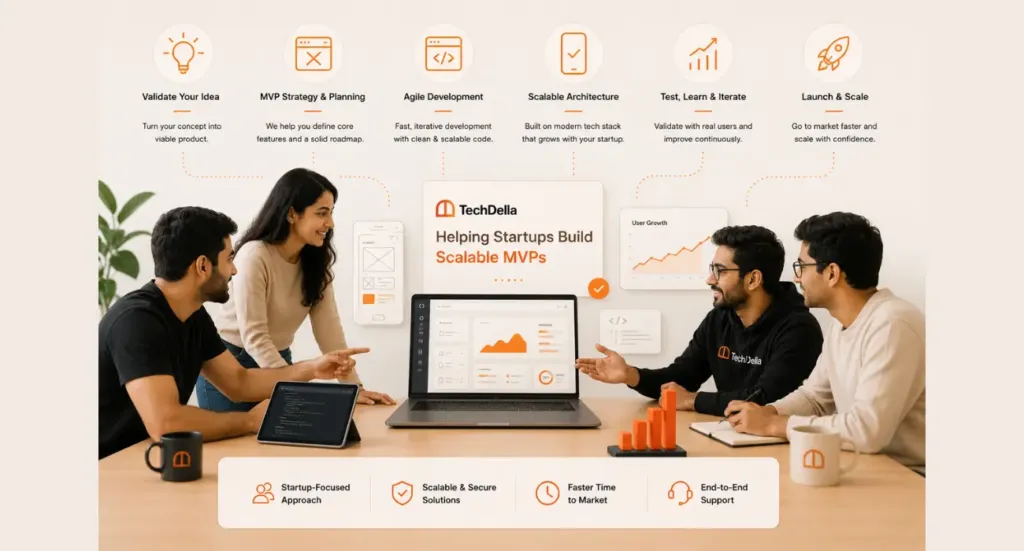
Our team works closely with startups to:
- Validate startup ideas
- Define product scope
- Prioritize MVP features
- Build fast and scalable products
- Improve user experience
- Reduce development waste
- Accelerate time-to-market
Whether you are building:
- SaaS products
- Fintech apps
- AI platforms
- Marketplaces
- Mobile applications
- Enterprise tools
Techdella helps founders move from concept to launch efficiently.
Why Startups Choose Techdella
1. Strategic Product Thinking
We do not just build apps. We help founders build products that users actually need.
2. Fast MVP Development
Our agile workflows help startups launch faster without sacrificing quality.
3. Scalable Architecture
We build MVPs with future growth in mind.
4. Startup-Focused Approach
We understand startup constraints, lean budgets, and fast-moving environments.
5. End-to-End Support
From idea validation to product launch and iteration, we support the entire journey.
If you are looking to build an MVP for your startup, Techdella can help you launch smarter and faster
Common MVP Development Mistakes
The first mistake is building too many features. More features do not always create more value. Often, they create confusion.
The second mistake is targeting too many users. A focused MVP for a narrow audience usually performs better than a broad product for everyone.
The third mistake is ignoring pricing. Even if you offer a free beta, you should still understand whether users would pay.
The fourth mistake is treating the MVP as low quality. Simple is good. Broken is not.
The fifth mistake is launching without feedback loops. If you do not collect feedback and measure behavior, your MVP cannot teach you much.
The sixth mistake is copying competitors too closely. Your MVP should be built around your unique user insight, not someone else’s feature list.
How Long Does It Take to Develop an MVP?
The timeline depends on complexity.
A landing page MVP may take a few days.
A no-code MVP may take two to four weeks.
A simple web app may take four to eight weeks.
A more complex marketplace, SaaS product, or mobile app may take eight to twelve weeks or more.
The right question is not only “How fast can we build?” The better question is “What is the smallest version we can launch that will teach us something valuable?”
Fast is useful only when you are learning the right thing.
How Much Does MVP Development Cost?
MVP cost depends on features, design complexity, platform, integrations, team location, and development method.
A simple no-code MVP can be relatively affordable.
A custom-coded MVP costs more but may be better for products that need scalability, security, or complex workflows.
A mobile app often costs more than a web MVP because it may require iOS, Android, testing, app store review, and device compatibility.
Founders should avoid asking for a price before defining the scope. Without a clear scope, estimates become guesses.
Before budgeting, define:
- Core features
- User roles
- Platform
- Integrations
- Admin needs
- Payment requirements
- Security needs
- Launch timeline
That gives your development team enough information to estimate realistically.
When Is Your MVP Successful?
An MVP is successful when it gives you clear evidence.
That evidence may be:
- Users are signing up.
- Users are completing the main action.
- Users are returning.
- Users are paying.
- Users are requesting more access.
- Users are recommending it.
- Users are replacing an old workflow with your product.
Even negative results can be useful. If users do not care, do not activate, or refuse to pay, you have learned something before spending more money.
That is still valuable.
The worst outcome is not a failed MVP. The worst outcome is spending a year building a product nobody wants.
Final Thoughts
Understanding how to develop an MVP is really about understanding how to reduce startup risk.
A strong MVP helps you test your idea, learn from real users, and make better product decisions before investing in a full build.
Start with a clear problem. Focus on one audience. Choose only the features needed to deliver the core value. Launch to a small group. Measure behavior. Listen carefully. Improve based on evidence.
That is how startups move from idea to product with less waste and more confidence.
Your MVP does not need to be perfect.
It needs to be useful, testable, and focused.
That is where real startup learning begins.