Running a service business sounds manageable until growth starts exposing every weak process underneath it.
Bookings come through WhatsApp. Payments are tracked manually. Client notes live across spreadsheets, DMs, and memory. At first, it works. Then suddenly, every new client adds more operational chaos instead of more revenue.
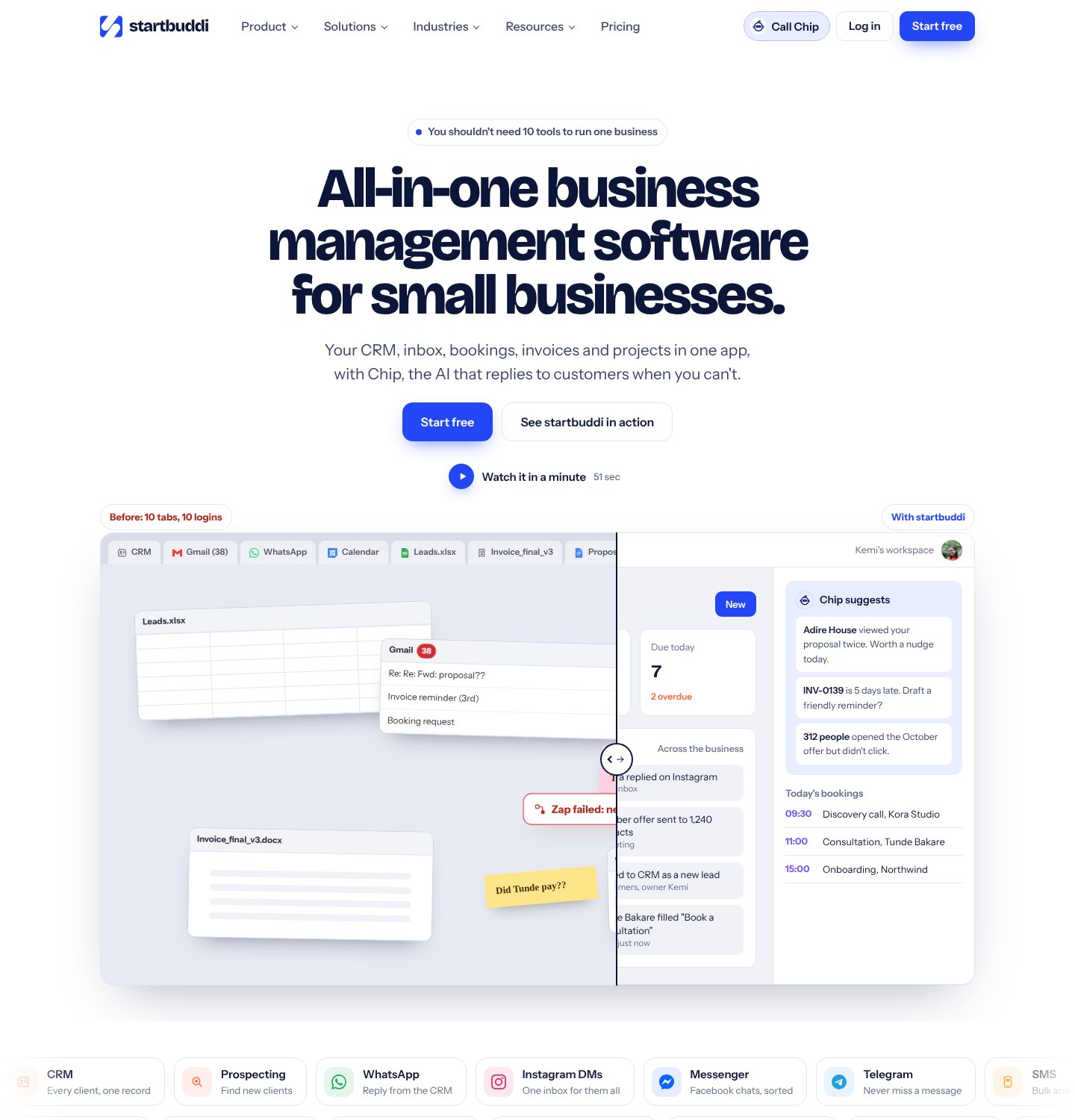
That was the reality behind startbuddi, a platform built to help service businesses manage bookings, payments, client relationships, and operations from one system.
But building the product was only part of the challenge.
The bigger question was this:
How do you position a platform for small business owners who are already overwhelmed by tools, admin work, and disconnected systems?
That is where we came in.
The Problem
Most service businesses do not fail because they lack skill.
They struggle because operations become fragmented as the business grows.
We kept seeing the same pattern:
- Client bookings are happening across multiple channels
- Payments are being manually chased
- Follow-ups getting missed
- Teams relying on disconnected apps to manage daily operations
In practice, this creates operational drag long before founders realize it is happening.
For startbuddi, the challenge was not just building software. It was creating a system that felt simple enough for busy service providers to actually adopt.
This became especially important for businesses trying to scale without adding unnecessary complexity.
That is a common issue in small-business management software and CRMs for servicebusinesses, where many tools add features faster than they solve workflow problems.
What Was Breaking
Early on, we noticed something important.
Most platforms in this space were built around features instead of operational clarity.
The assumption was “More tools equal better productivity.”
But for many service businesses, the opposite was happening.
The more platforms they added, the harder daily operations became.
- Scheduling lived in one app.
- Invoices lived somewhere else.
- Client conversations happened in WhatsApp.
- Marketing performance was disconnected from bookings.
That fragmentation slows decision-making and quietly affects revenue.
If a founder cannot clearly see bookings, payments, client history, and follow-ups in one place, growth starts feeling heavier instead of smoother.

Our Approach
We did not want startbuddi to feel like another complicated business platform.
So instead of leading with features, we focused on operational simplicity.
Here is what we prioritized first:
1. Clarity before expansion
Before adding more functionality, we focused on helping users understand their business in one place.
That meant simplifying:
- Booking flows
- Client management
- Payment tracking
- Follow-ups
- Daily business visibility
This became central to positioning startbuddi as an all-in-one business management platform rather than just another scheduling tool.
2. Messaging around real operational pain
Most business owners are not searching for “advanced automation systems.”
They are trying to solve practical problems like:
- missed bookings
- late payments
- scattered client information
- inconsistent follow-ups
So we shaped messaging around those real frustrations instead of technical features.
That shift made the product feel more relatable and easier to understand.
3. Building around how service businesses actually work
A lot of software assumes businesses already operate with structured systems.
But many early-stage service businesses grow through WhatsApp conversations, referrals, spreadsheets, and manual processes first.
startbuddi needed to meet users where they already were.
That is why the platform focused heavily on:
- automated booking systems
- integrated payments
- CRM functionality
- workflow automation
- AI-assisted business support
All inside one operational flow.
Implementation in Practice
The collaboration focused on creating a product experience that reduced operational stress instead of adding more admin work.
We helped shape how the platform communicated value across:
- product positioning
- operational workflow clarity
- founder-focused messaging
- onboarding simplicity
- customer pain-point alignment
Instead of overwhelming users with software language, the focus stayed on outcomes:
- fewer manual tasks
- easier client management
- cleaner operations
- better visibility into business activity
That positioning became especially important for founders looking for business automation tools for small businesses and client management software for service providers without needing enterprise-level systems.
Outcomes and Impact
The biggest shift was clarity.
startbuddi evolved into a platform that made operational management feel more manageable for service businesses juggling growth and daily execution.
The platform now helps businesses:
- centralize bookings and client data
- reduce manual follow-ups
- automate invoicing and reminders
- track business activity from one dashboard
- simplify operational workflows
More importantly, the messaging now reflects the actual reality of service business owners instead of sounding like generic SaaS marketing.
That difference matters.
Because founders do not need more software noise.
They need systems that reduce friction and help them operate with more confidence.
Key Takeaway
Most operational problems inside service businesses are not caused by a lack of effort.
They usually come from disconnected systems, unclear workflows, and tools that were never designed to work together.
What actually moves the needle is not adding more software.
It is creating a simpler operating system around the way the business already works.
That was the goal behind startbuddi from the beginning. And it shaped how we approached the entire collaboration.